
Why Europeans are shocked by Matmata is simple — nothing prepares you for a village where entire homes are hidden underground, carved directly into the hills of the Dahar plateau.
We include Matmata as part of our Sahara 2 day tour, and we also organize it as a private one-day trip combined with El Jem.
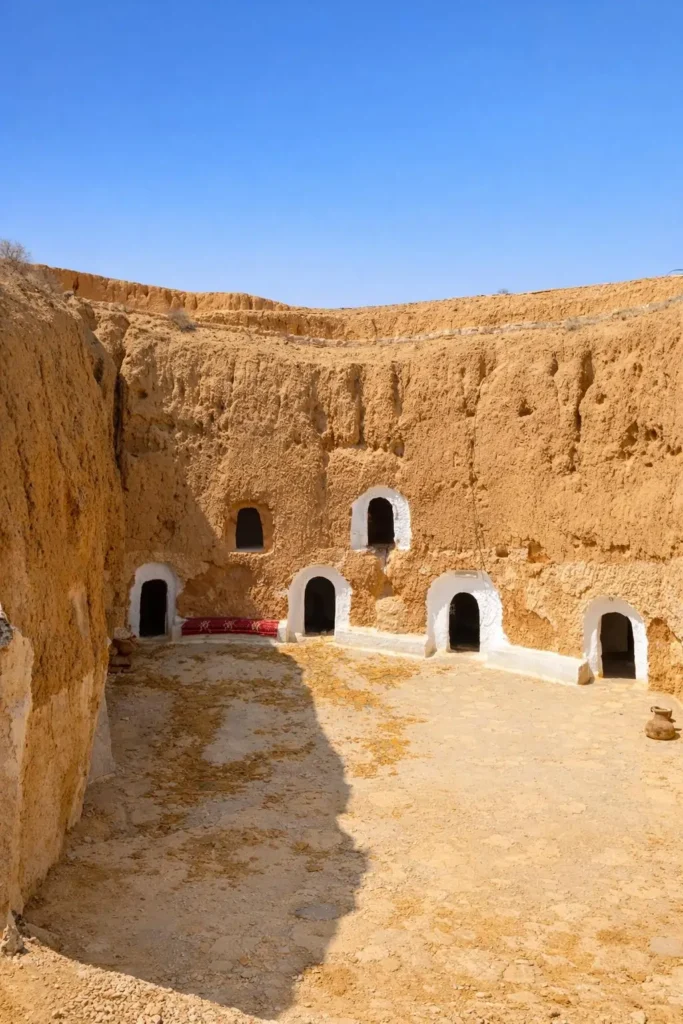
Why Europeans are shocked by Matmata becomes clear the moment you arrive. Matmata is a Berber village in southern Tunisia, located on the Dahar plateau between desert steppe and mountains. Local families carved entire homes underground, using soft limestone, sandstone, and clay. Inside these homes, temperatures stay around 20°C even during extreme summer heat. We organize visits to Matmata as part of our Sahara 2 day tour and as a private day trip with El Jem.

The First Shock: Why Europeans Are Shocked by Matmata
Most travelers cross the southern Tunisian steppe without expecting anything unusual. The landscape stretches flat and dry toward the horizon. However, at some point, small white markings appear on the hills.
These markings are entrances to underground homes.
Travelers often say this moment feels like stepping into a different film entirely — quiet, empty hills that hide entire families living beneath the surface. Nothing on the drive prepares you for it. Because of this, Matmata consistently surprises visitors more than almost any other stop in southern Tunisia.
If you are also planning the wider route, we cover El Jem Amphitheatre and [the Sahara 2 day tour] in separate guides.
Why Europeans Are Shocked by Matmata Underground Houses
Local families built these houses from layers of clay, gypsum, and soft rock. As a result, these materials provide excellent natural insulation.
Even when outside temperatures climb well above 40°C in summer, the inside of a Matmata home stays close to 20°C. Families dug rooms directly into hillsides, creating bedrooms, kitchens, and storage spaces connected through underground corridors.
Instead of building upward like most architecture Europeans recognize, Matmata families built downward — and the result still works perfectly today.

The Berber History That Explains the Shock
Matmata belongs to the Berbers. Berber people, the indigenous people of Tunisia who lived in the region long before the Arab conquest in the 7th century.
After the conquest, many Berbers were killed, while others converted to Christianity or Islam. However, many Berber communities refused to give up their language, customs, and beliefs. Instead, they retreated into remote areas — including underground villages like Matmata and mountain hideouts such as Chebika.
Local guides also share the story of a Berber princess who led her people’s resistance when Arab forces advanced into the region. According to the legend, she and her warriors took shelter inside the El Jem amphitheater, using its massive walls as a stronghold. From there, they resisted for a long time — the Arab forces could not break through the amphitheater’s defenses.
The legend also speaks of a secret underground passage beneath El Jem, stretching for kilometers and leading to an exit near the coast, where supplies and food were brought in. Eventually, according to the story, Arab forces managed to break through the walls, and the princess lost her life defending her people.

Why Europeans Are Shocked by Matmata: The Berber Family Visit
While details vary between storytellers, the story reflects how deeply Berber communities fought to preserve their way of life, and visitors exploring the underground passages of El Jem today can still see this tunnel for themselves.
Matmata itself remained largely unknown to the outside world until 1969, when severe flooding forced residents to seek help from local authorities for the first time. Afterward, the government supported the construction of above-ground housing nearby. Many families moved out — but many also kept their original underground homes, either for tradition, nostalgia, or to welcome visitors today.
We arrange visits to an authentic underground home, where a Berber family welcomes guests directly into their world.
Hosts typically offer Berber bread with olive oil and honey, along with tea, almonds, and dried fruit. Afterward, visitors walk through the underground rooms — kitchens, bedrooms, and storage areas carved into a single hillside.
Cats rest everywhere throughout these homes, adding to the quiet, lived-in atmosphere. Walking from room to room, guests quickly realize that families hollowed out an entire hill into a functioning home — something photos rarely capture properly.
Matmata and Star Wars – One More Surprise
Matmata gained additional fame as a Star Wars filming location.
Today, the house used for young Luke Skywalker’s home operates as Hotel Sidi Driss — a restored hotel that still displays original Star Wars props. In addition to the underground homes, this stop adds a cinematic layer that many guests don’t expect to find in rural Tunisia.
Another Surprise: Matmata Looks Like Mad Max Beyond Thunderdome
If the underground houses in Matmata look familiar, there is a reason.
Mad Max Beyond Thunderdome features almost identical underground homes. However, the film was shot in Coober Pedy, Australia, not Tunisia. Unlike Star Wars, which used real locations in Matmata, the Mad Max films were filmed entirely in Australia.
At the same time, Coober Pedy shares something important with Matmata: extreme heat. Both communities independently developed the same solution — digging homes into the earth to escape temperatures that regular houses cannot handle.
As a result, two completely different cultures, thousands of kilometers apart, arrived at strikingly similar architecture for the same reason. Visitors who recognize the look from Mad Max often say this connection becomes one of the most surprising parts of the entire Matmata story.This is another reason why Europeans are shocked by Matmata — the connections keep appearing from unexpected directions.
Matmata as Part of the Sahara 2 Day Tour
We include Matmata as a core stop on our Sahara 2 day private tour from Sousse, Monastir, Hammamet, and Mahdia.
After visiting El Jem Amphitheatre, the route continues directly into Matmata before heading toward Douz and the desert dunes. Because of this, Matmata fits naturally into the wider Sahara experience — a transition point between Roman history and the desert that follows.
El Jem and Matmata Day Trip – The One-Day Option
For guests with limited time, we also organize a private one-day trip covering both El Jem and Matmata.
This option works well for travelers who want to experience the underground houses and Roman history without committing to a full Sahara tour. We arrange pickup from Sousse, Monastir, Hammamet, and Mahdia, with flexible timing throughout the day.
Many guests tell us this becomes one of the most unexpected days of their entire Tunisia holiday and far more memorable than they imagined before arriving.

Practical Information – Matmata Tunisia Tours
Available as: Part of the Sahara 2 day tour, or a private El Jem and Matmata day trip
Departures from: Sousse, Monastir, Hammamet, Mahdia
Includes: Private transport, local guide, visit to an underground Berber home
Suitable for: Families, children, couples, history and culture travelers
Pricing: Depends on the option chosen and group size — contact us for current rates
FAQ – Why Europeans Are Shocked by Matmata Tunisia
Can Matmata be visited in one day from Sousse, Monastir, Hammamet, or Mahdia?
Yes. We organize a private day trip combining El Jem and Matmata, with pickup and drop-off from all four locations.
Is Matmata part of the Sahara 2 day tour?
Yes. Matmata is one of the main stops on our Sahara 2 day private tour, between El Jem and the desert region around Douz.
Can we visit a real Berber family home in Matmata?
Yes. We arrange visits to an authentic underground home, where a local Berber family welcomes guests and shares traditional food and tea.